

One things that struck me after running a recent Webinar on AI was how many people think that by simply subscribing to ‘AI’ your business will automatically improve. While there is a lot on social (and general) media about the benefits of AI (the latest being the advancements in Claude Cowork) there is also, quite simply a lot of guff out there. Just subscribing to Copilot for 10 people to play with in the office is never going to yield the volume and type of change that is going to make a dent in your business. Sure, your Marketing team can create cool looking graphics and automate social posts, yep Finance can make fancy spreadsheets with colours and even conditional formatting but is that going to raise EBITDA or grow Revenue by 5% ?
Nope.
What might make a dent is an AI strategy that is properly implemented, and that isn’t going to happen without first looking at data and file locations.
Many (many !) clients think a SharePoint project ends when the data is transferred (warts and all) from on-prem to M365 when in fact that is only part way through. If you want that data to become a knowledge source for future AI initiatives and agents it needs to be organised, structured and labelled.
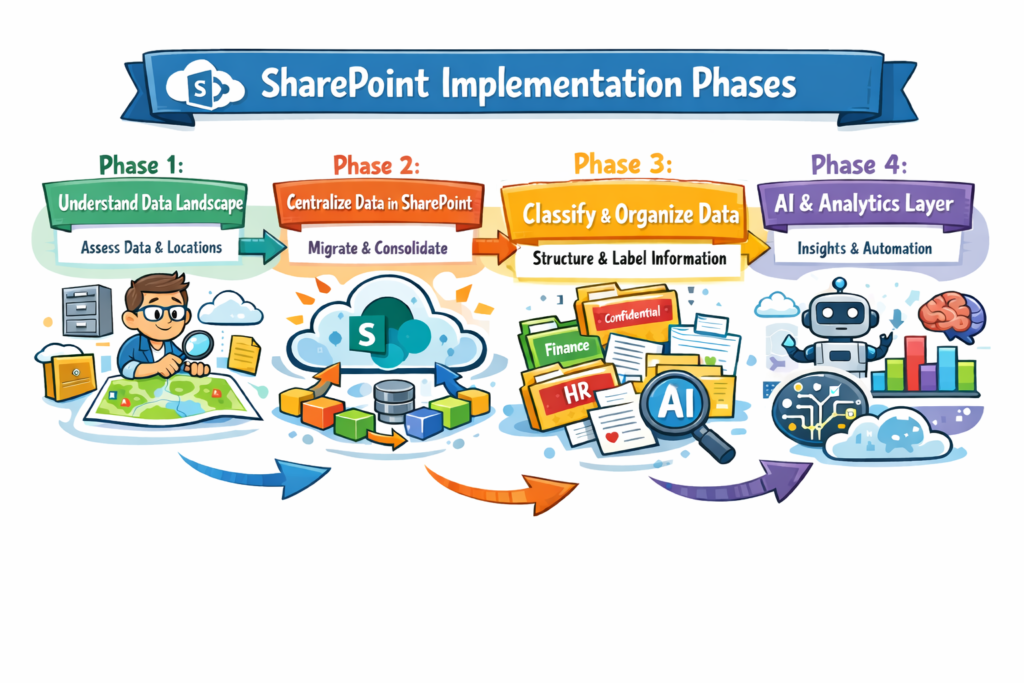
These are some of the main steps you need to consider for such a project;
AI Is Only as Good as the Data Beneath It
There’s a narrative in the market that AI is transformative by default. Shockingly it isn’t.
AI is powerful — but only when it sits on top of structured, governed, compliant data. Without that foundation, it’s just an expensive experiment or worse, a confidence illusion.
If you care about the welfare of your company’s data — and that is ‘if’ — then AI adoption isn’t about which tool fits best. It’s a data maturity journey.
In my experience advising organisations across Microsoft 365, ERP, and business platforms, the path to extracting real value from AI follows a four-stage framework;
- Understand your Data Landscape
- Centralise Key Data
- Classify & Organise Data
- Apply the Right Analytics & AI Layers
It breaks down like this;
Stage 1: Understand the Data Landscape
Assess Data & Locations
Before AI, before automation, before Copilot — you need clarity.
Most organisations don’t realise just how fragmented their data estate is:
- File shares
- Legacy on-prem servers
- SharePoint sites with no governance
- Personal OneDrives
- Email attachments as “document management”
- Line-of-business systems storing isolated datasets
Key Considerations
- Where is your critical data actually stored?
- Who owns it?
- Is it duplicated?
- Which is the ‘Master’ version or do you upload everything ?
- Is it structured or unstructured?
- Are there regulatory obligations (GDPR, financial retention, sector compliance)?
- What data is sensitive vs operational vs archival?
This stage is not glamorous. It is forensic.
It often involves:
- Data discovery exercises
- Stakeholder workshops
- Risk assessment
- Retention policy reviews
- Understanding integration points between ERP, CRM, HR, Case Management, DMS and M365
Benefits of Stage 1
- Visibility of risk exposure
- Reduced shadow IT
- Clarity on duplication and sprawl
- Identification of quick wins
- A defined scope for transformation
Without this stage, AI simply amplifies disorder and will quickly get relegated to the ‘tried it and it didn’t work’ bin
Stage 2: Centralise Key Data
Migrate & Consolidate
AI thrives on accessible, unified data.
If your information is siloed across multiple systems with no integration, your AI outputs will be fragmented, incomplete, and context-poor.
This is where platforms like SharePoint Online, Dataverse, modern ERP, and secure cloud repositories come into play.
What Centralisation Really Means
It doesn’t mean “dump everything in one place and forget about it”
It means:
- Creating structured repositories
- Designing information architecture
- Migrating from legacy file shares
- Eliminating redundant systems
- Connecting ERP, HR, and CRM environments
- Establishing clear ownership
Key Considerations
- Migration methodology (lift-and-shift vs restructure)
- Versions and ‘cleanliness’ of data being moved
- Metadata models
- Security inheritance models
- User adoption strategy
- Integration architecture
Benefits of Stage 2
- Single source of truth
- Reduced duplication
- Improved collaboration
- Lower infrastructure overhead
- AI readiness
Centralisation moves you from chaos to coherence.
But coherence without control is still risky — which brings us to Stage 3.
Stage 3: Classify & Organise Data
Structure & Label Information
This is the stage most organisations skip, the data’s in the Cloud so were done right ? Wrong ! This is the stage that determines whether AI becomes transformational or dangerous.
AI engines don’t “understand” context the way humans do. They rely on structure, labels, permissions, and semantic signals.
If your sensitive HR files sit in the same library as marketing brochures with open permissions, AI will not instinctively correct that mistake.
What This Stage Involves
- Sensitivity labels
- Retention labels
- Metadata standardisation
- Role-based access controls
- Naming conventions
- Information architecture refinement
- Automated classification policies
Governance Is Not Bureaucracy
Governance is protection:
- Protection of confidential data
- Protection of intellectual property
- Protection of regulatory compliance
- Protection of board-level trust
Benefits of Stage 3
- Reduced data leakage risk
- Clear compliance posture
- Audit readiness
- AI grounded in context
- More accurate search and retrieval
This is where data welfare becomes real.
You move from storage to stewardship.
Only now are your AI Readiness is through the roof
Stage 4: Apply the Right Analytics & AI Layers
Insights & Automation
Once data is structured, secure, and centralised — AI becomes a multiplier.
Now you can responsibly deploy:
- Copilot-style productivity AI
- Predictive analytics
- Workflow automation
- Document intelligence
- ERP insight generation
- Board-level reporting automation
- AI-driven knowledge retrieval
Key Considerations
- Executive ownership
- Financial metrics alignment
- Governance from day one
- Defined use cases
- Measurable ROI
- Ongoing monitoring
AI should align to business objectives, not experimentation agendas.
Benefits of Stage 4
- Faster decision-making
- Reduced manual effort
- Operational efficiency
- Enhanced customer insight
- Competitive differentiation
This is where the value multipliers kick in
Notice also that AI is the final stage rather than the starting point.
The Bigger Message: AI Is a Tool, Not a Strategy
AI alone is not transformation
It is not governance
It is not compliance
It is purely an amplifier
If done poorly (or not at all AI will simply amplify your issues and probable create new ones
If your data estate is structured and governed, AI can amplify intelligence.
Final Thought
If you are considering AI in your business, ask yourself:
- Are we doing this just because it’s new and trendy or is there an actual need ?
- Do we truly understand our data landscape?
- Is our information centralised and structured?
- Is it classified and governed?
- Do we have executive ownership of AI initiatives?
Before you rush off and subscribe to any of these amazing AI saviours make sure you’re not simply reacting to hype and make sure you consider all the steps you’ll need to take to ensure positive amplification rather than simply another mediocre initiative.
Simon
